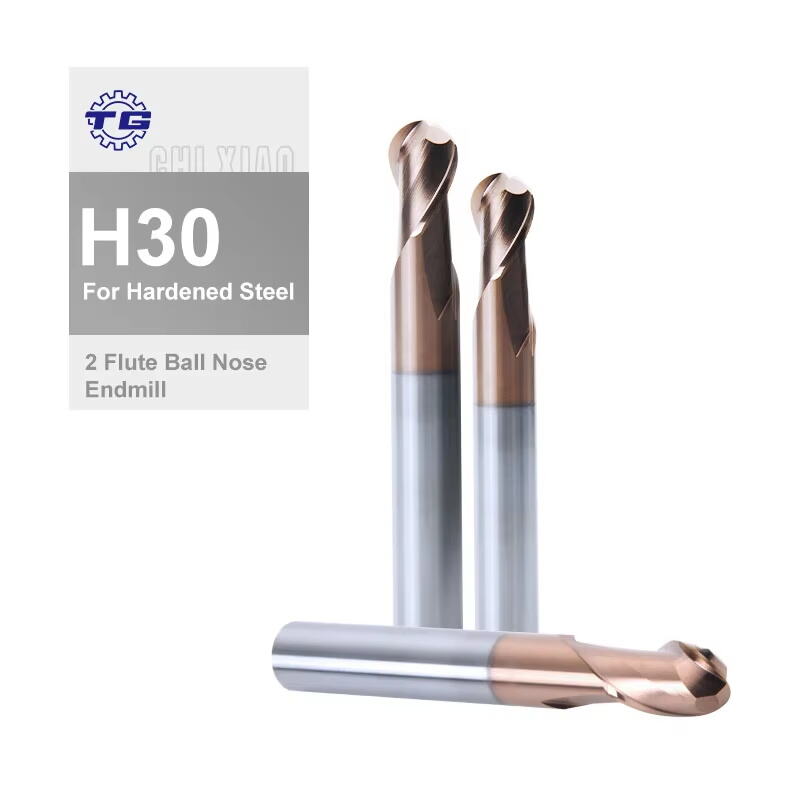
Superior Precision and Surface Quality Achievement
Achieving consistent precision and exceptional surface quality represents fundamental requirements in modern manufacturing, and solid carbide cutting tools deliver both attributes with remarkable reliability. The homogeneous carbide construction provides inherent rigidity that prevents deflection during cutting operations, a critical characteristic when producing components with tight dimensional tolerances or intricate geometric features. When a cutting tool flexes under load, it produces dimensional inaccuracies and surface imperfections that compromise part quality. Solid carbide cutting tools resist these deflection forces through their exceptional stiffness, maintaining their intended cutting path with minimal deviation. This rigidity proves particularly valuable when machining deep pockets, narrow slots, or components with high length-to-diameter ratios where deflection typically presents significant challenges. The precision-ground cutting edges on these tools represent another crucial factor in their quality performance. Manufacturers produce solid carbide cutting tools using advanced grinding equipment capable of achieving edge preparations measured in micrometers, creating cutting geometries that precisely match theoretical designs. These accurate edge geometries ensure consistent chip formation and cutting forces, producing uniform surface finishes across entire production runs. You will observe that parts machined with solid carbide cutting tools require less subsequent finishing work, as the superior surface quality often eliminates grinding, polishing, or other secondary operations. This capability reduces your processing costs while shortening production lead times, enhancing competitiveness in time-sensitive markets. The thermal stability of carbide material further contributes to precision maintenance. During cutting operations, friction generates substantial heat that can cause tool expansion and dimensional changes. Solid carbide cutting tools exhibit minimal thermal expansion compared to steel-bodied alternatives, maintaining their dimensions even under elevated temperature conditions. This stability ensures that the first part produced in a run exhibits the same dimensional characteristics as the final part, eliminating the dimensional drift commonly experienced with less stable tooling materials. Advanced coating technologies applied to solid carbide cutting tools enhance their precision capabilities even further. Specialized surface treatments reduce friction between the tool and workpiece, lowering cutting temperatures and minimizing built-up edge formation that can mar surface finishes. These coatings also provide chemical barriers that prevent workpiece materials from welding to cutting edges, maintaining clean, sharp cutting geometries throughout extended operations. For manufacturers serving industries with stringent quality requirements such as aerospace, medical devices, or precision instrumentation, the dimensional accuracy and surface quality delivered by solid carbide cutting tools often represents the difference between acceptable and rejected components, directly protecting revenue and reputation.

 EN
EN